How to Choose a Hair Mask OEM Manufacturer in China (2026 Buyer's Guide)
A practical 7-point checklist for beauty brands sourcing hair masks from China — formulation capability, compliance, MOQ, packaging, testing and red flags to avoid.
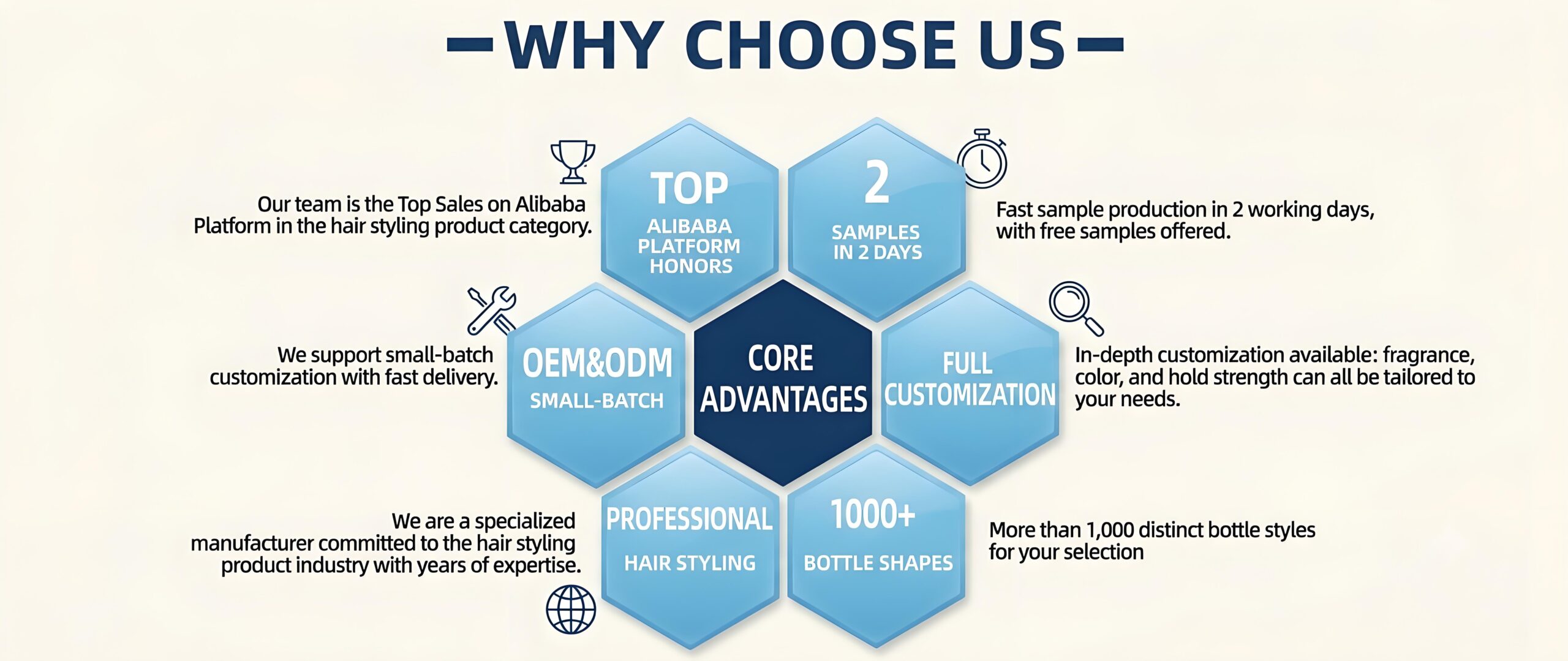
Choosing the right hair mask manufacturer starts with the right checklist — here is the one buyers actually use.
The checklist that separates good factories from expensive lessons
Choosing where to make your hair mask is one of the highest-leverage decisions a hair care brand makes. The formula determines whether customers reorder; the manufacturer determines whether that formula can be produced consistently, compliantly, and at a margin that works.
China remains the world’s densest cluster of hair care manufacturing capability — but density is not the same as quality. Here is the checklist experienced buyers actually use.
- The right hair mask OEM partner is judged on formulation capability, not on catalogue size.
- MOQ is usually driven by packaging and filling, not by the formula itself.
- Ask for claims substantiation (humidity resistance, heat protection, bond repair) before you believe a performance claim.
- A good factory will send a technical dossier (COA, SDS, stability data) in English without being asked twice.
- Sampling speed is the single best predictor of how the mass-production relationship will go.
The 7-point checklist
Work through each point with every shortlisted factory. The answers, more than the certificates, tell you who you are really dealing with.
Formulation capability comes first
A supplier that only rebrands stock formulas can serve you today, but cannot help you build anything defensible. Ask:
- Is there an in-house laboratory and formulation team, or is everything outsourced?
- Can they work with the actives you care about — hydrolysed keratin, argan oil, amino acid complexes, bond-building agents, silicone-free conditioning systems?
- Can they reverse-engineer a benchmark you admire, within compliant limits?
A manufacturer with real formulation depth will talk in percentages, pH windows, and viscosity ranges. A trading company will talk in catalogue numbers.

Ask to see the lab, not just the catalogue — formulation depth lives behind these doors.
Compliance for your market, not theirs
A factory can be excellent and still be wrong for you. Hair masks sold in the EU must comply with EU 1223/2009 (CPNP notification, responsible person, PIF). In the US, MoCRA adds facility registration and product listing obligations. Southeast Asia, the Gulf and Latin America each have their own registration paths.
Ask specifically: “Have you shipped hair masks to [your market] before? Can you provide the documentation our regulator requires?” Past experience with your destination market is worth more than any certificate on a wall.
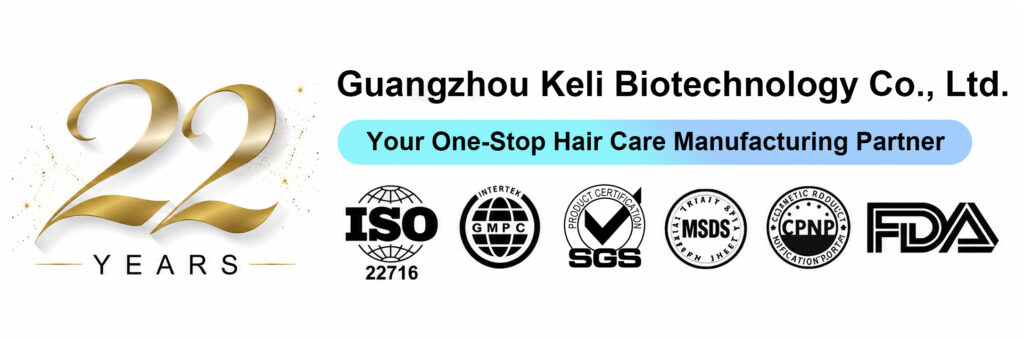
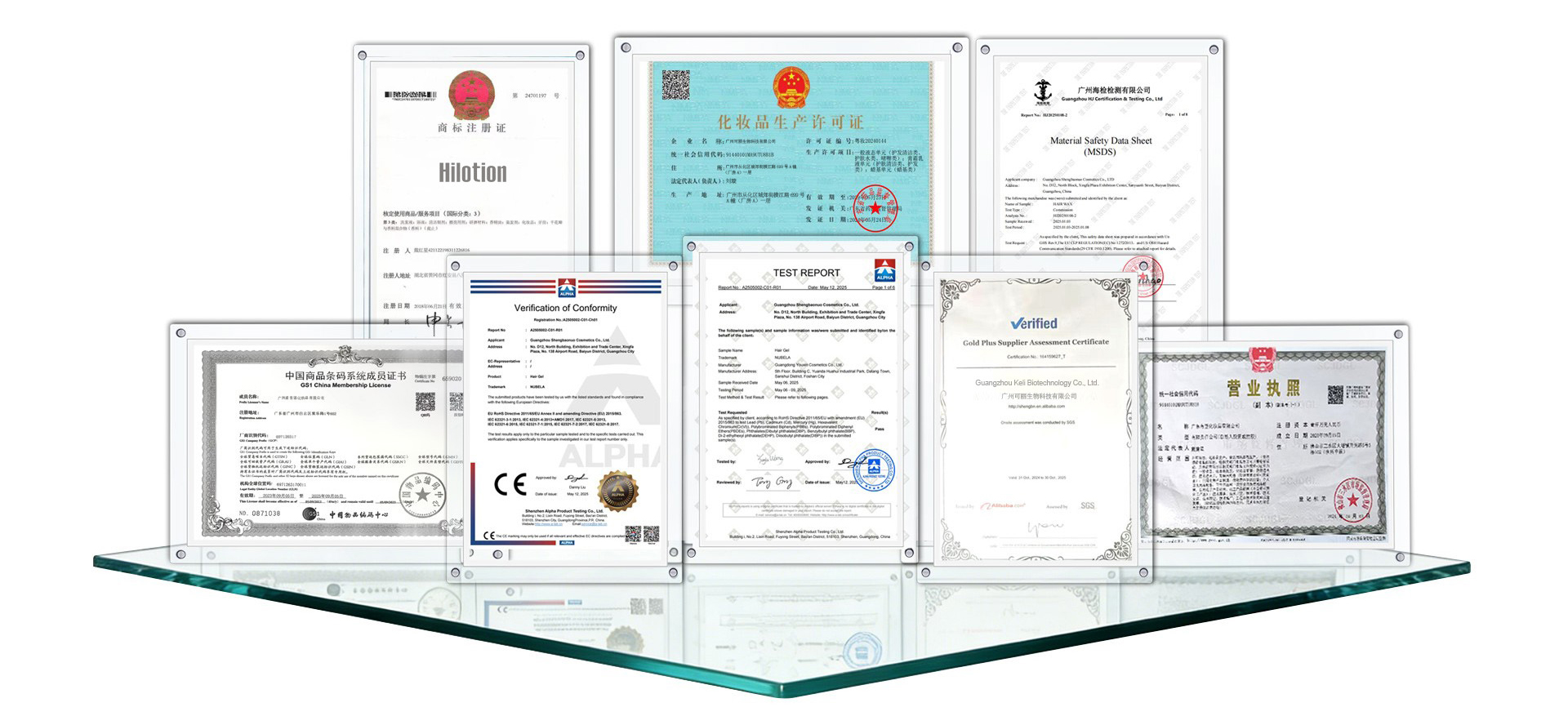
Certificates belong on the wall and in your file — verify them with the issuing body before you trust them.
Understand where the MOQ really comes from
New brands are often shocked by minimum order quantities. The formula is rarely the constraint — packaging is. A custom jar, tube or sachet may carry a 10,000–20,000 unit minimum from the packaging supplier, while the bulk formula can often be made from a few hundred kilos.
Two practical routes lower the barrier:
- Stock formula + custom packaging (private label): fastest, lowest risk, moderate differentiation.
- Stock packaging + custom formula: strong differentiation, low entry volume.
Manufacturers such as Guangzhou Keli Biotechnology, which produce both stock and custom hair mask lines in-house, can usually quote both paths side by side — worth asking for that comparison explicitly.
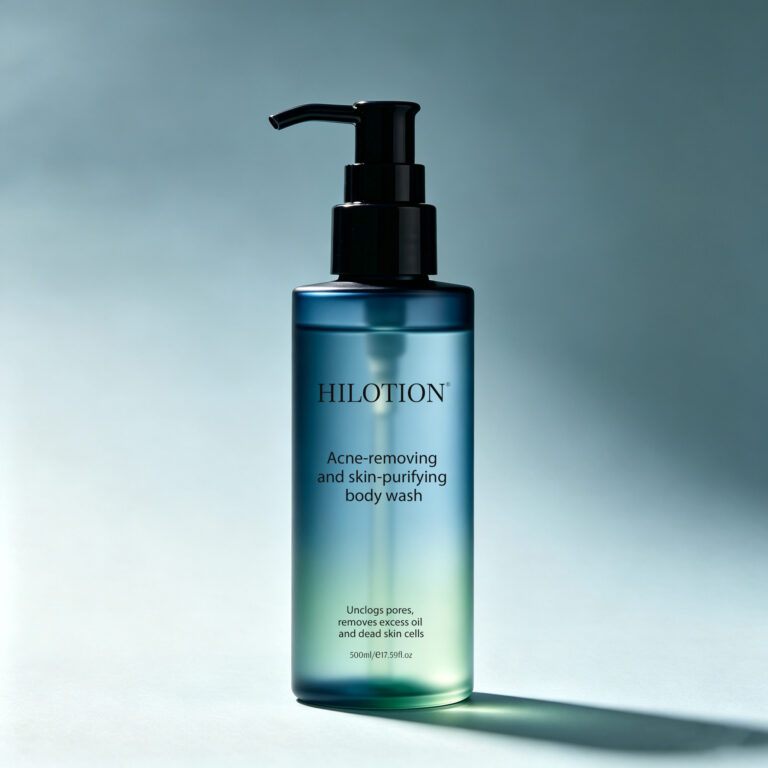
Stock formula plus custom packaging is the fastest private-label route — ask for both quotes side by side.
Packaging compatibility is a technical question
Hair masks are thicker than shampoos, often with high oil-phase content. That changes everything downstream:
- Jar vs tube vs sachet changes filling temperature and viscosity requirements.
- High-oil formulas can stress certain plastics and closures.
- Airless packaging may be needed for sensitive actives.
Ask the factory to confirm filling compatibility before you pay for tooling. This is one of the most common and most expensive mistakes new brands make.

Serious manufacturers test filling compatibility with your chosen packaging — before you pay for tooling.
Demand claims substantiation
“Repairs damage”, “humidity resistance”, “heat protection up to 230°C” — these are marketing claims until someone tests them. A serious manufacturer can arrange or support:
- Treated vs untreated half-head comparison testing
- Humidity chamber curl-retention or frizz assessment
- Instrumental combing-force or tensile-strength measurement
If a supplier cannot explain how a claim was tested, assume it was not.
Sampling speed predicts the relationship
Time from brief to first sample tells you more than any presentation. A responsive partner returns a first lab sample in roughly 2–4 weeks and iterates quickly. If the first round takes two months, the fourth round will take longer.

Sampling speed is the single best predictor of how the mass-production relationship will go.
Communication and documentation quality
You will exchange specifications, safety data, artwork requirements and shipping documents for years. Judge the first month carefully:
- Are technical answers specific, or vague and salesy?
- Is there a single accountable contact (not a rotating inbox)?
- Are documents (COA, SDS, stability, microbiological) available in English?
A single accountable contact who knows your file beats a rotating inbox every time.
Red flags to walk away from
If you hear any of these, no discount is worth the risk.
Refusal to share test data
No COA, no stability report, no factory audit information — a serious partner publishes these before you ask twice.
Pressure to pay 100% upfront
Reputable manufacturers work on balanced payment terms. Demand for full payment before production is a red flag.
Formulas that cannot be adjusted at all
A locked-in-total formula means you cannot fix problems discovered in sampling or your market.
Certificates that cannot be verified
Check with the issuing body. An unverifiable certificate is worse than none at all.
Frequently asked questions
How long does it take to develop a custom hair mask?
Typically 4–8 weeks for formulation and sampling, plus 3–6 weeks for production and filling once approved. Custom packaging tooling can add 2–4 weeks.
Can I use my own fragrance and packaging design?
Yes. Most OEM partners support custom fragrance, colour, viscosity, and artwork, subject to MOQ and compatibility testing.
What is a reasonable first order for a new brand?
For private label using stock formulas, MOQs can start in the low thousands of units. Fully custom formulas with custom packaging typically start higher.
Should I visit the factory?
If volume justifies it, yes — or commission a third-party audit. Video walkthroughs are a reasonable first step.

A dedicated production facility, not a trading desk — this is the manufacturing capacity behind the samples.
Ready to talk about your hair mask line?
Get a quote, a sample plan and an honest MOQ answer — usually within one working day.
WhatsApp: +86 186 2006 1019